
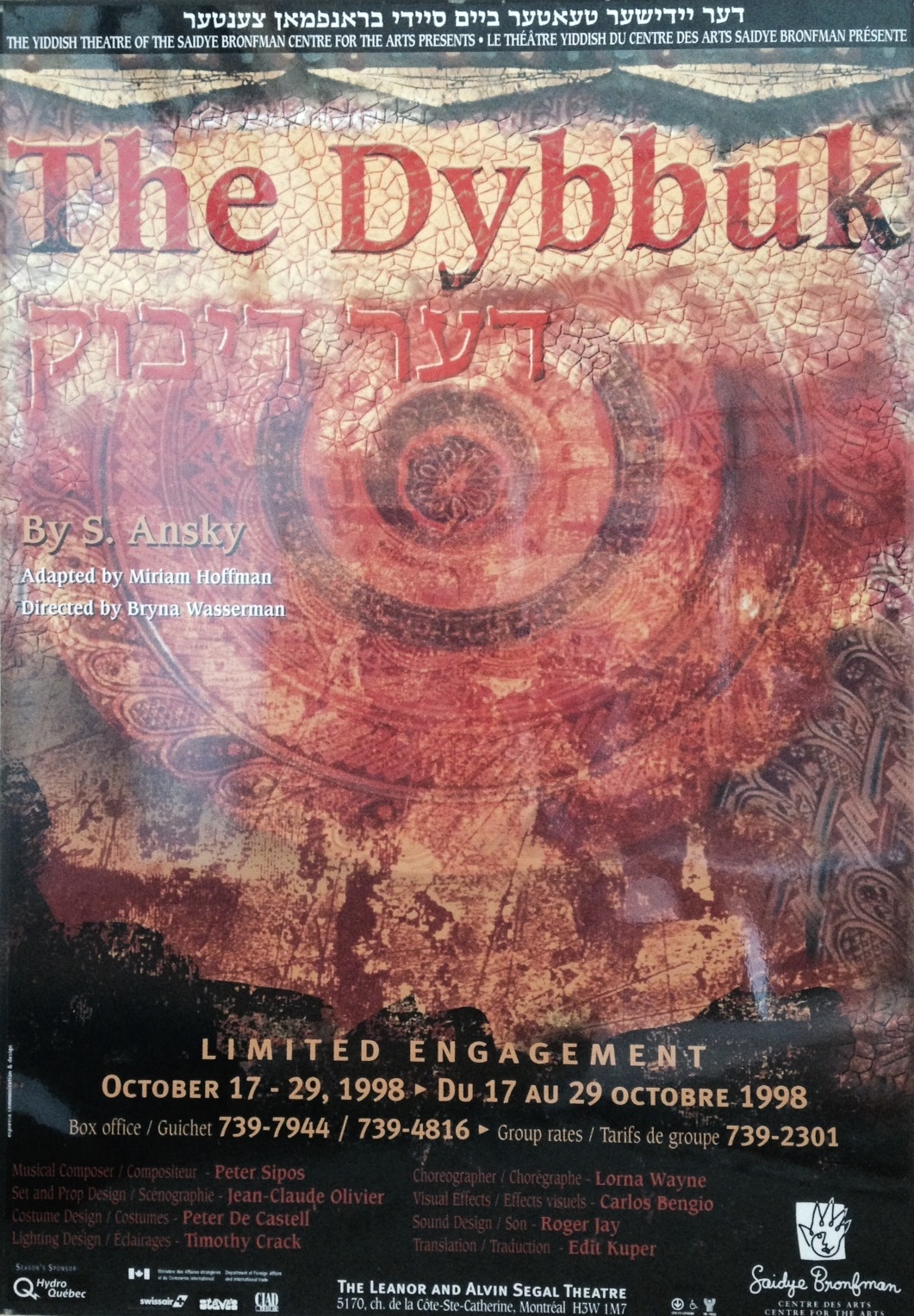
The Dybbuk
Original Music For The Classic Yiddish Drama
Music by Peter Sipos
Directed by Bryna Wasserman
Book by S. Ansky
Saidye Bronfman Centre, Montreal — 1998
A haunting story of love, loss and possession, brought to the Montreal stage in traditional Yiddish with an original dramatic score by Peter Sipos.
A HAUNTING YIDDISH CLASSIC
The Dybbuk is one of the most celebrated works of Yiddish theatre—a powerful supernatural drama in which the worlds of the living and the dead become tragically intertwined.
At its heart is the story of Leah and Khonen, two young people whose lives are bound together by love and by a promise made before they were born. When Leah’s father arranges for her to marry another man, the impoverished Khonen turns increasingly towards mysticism in his desperation to prevent their separation.
Khonen dies, but his love for Leah proves stronger than death. His restless spirit returns as a dybbuk—a wandering soul that enters and possesses the body of a living person. On the day of Leah’s wedding, Khonen’s spirit takes possession of her, setting in motion a struggle between love, religious authority and forces beyond the visible world.
The play moves between earthly life and Jewish mysticism, asking whether the bond between two souls can be broken by family, society—or even death itself.
In 1998, three years after the first production of Jeanne, the Saidye Bronfman Centre invited Peter Sipos to compose original music for a new Montreal production of this classic drama.
The invitation was an important recognition of Peter’s growing reputation within Montreal theatre. The same venue that had first presented Jeanne now entrusted him with the musical atmosphere of one of the most significant works in the Yiddish theatrical tradition.
The production was performed in traditional Yiddish, primarily for Montreal’s Jewish community. To make the drama accessible to a wider audience, English and French surtitles were projected above the stage in a manner similar to those used in opera.
COMPOSING THE UNSEEN WORLD
For Peter, The Dybbuk presented a very different musical challenge.
This was not a conventional musical in which songs carried the characters and story forward. Peter was asked to create something more elusive: a cinematic dramatic score that could live beneath the action, heightening the atmosphere without overwhelming the words or performances.
The music had to evoke the play’s unseen world—the mystery surrounding Khonen, Leah’s possession and the uneasy boundary between the living and the dead. It was Peter’s first experience of composing an extended mystical and dramatic underscore for the theatre.
The commission also represented another professional milestone. It was the first time Peter had been formally engaged to write theatrical music to order, receiving an advance and continuing royalties for his work.
Although the production was principally a spoken drama, Peter persuaded director Bryna Wasserman to include one original song, performed in Yiddish by one of the central characters.
This presented Peter with a new way of working. Throughout his previous musical-theatre collaborations, he had generally composed a melody first, with words added afterwards. For The Dybbuk, the Yiddish lyrics were written before the music, requiring Peter to shape his composition around the rhythm, meaning and emotional character of an existing text.
It was the first time in his career that he had composed a song in this way.
Peter wrote and recorded the complete score in his newly rebuilt home studio. The finished music was delivered to the theatre on CD, ready to be played at the precisely chosen moments within the production.
This allowed Peter to create a fully realised musical soundscape, combining the control of a studio recording with the immediacy of live drama. Each passage could be designed to accompany a particular moment, transition or change of atmosphere on stage.
The result was warmly received by the theatre’s management and by critics. The production itself proved successful and was revived several times in subsequent years. Peter records that the original Montreal company later took the work to Vienna, carrying his music with it beyond Canada.
AN IMPORTANT MUSICAL DEPARTURE
The Dybbuk was a more modest undertaking than Peter’s large-scale musicals, but it occupied an important place in his development as a theatrical composer.
It demonstrated that his music could do more than accompany songs. It could establish atmosphere, reveal an emotional undercurrent and give musical form to ideas that could not be seen or spoken.
The commission also renewed Peter’s creative momentum at an important point in his career. Three years after Jeanne, the confidence placed in him by the Saidye Bronfman Centre confirmed that his contribution to Montreal theatre had not been forgotten.
The experience left him with a renewed desire to begin another major musical project—even though he did not yet know what that musical would be or with whom he would create it.
Before long, a telephone call from Martin Charnin would provide the answer and begin the next chapter in Peter’s theatrical journey.