
Explore the Hungária Story
Hungária
The Beat of a Generation
From packed Budapest clubs and nationwide success to recording studios, international tours and an audacious journey across the Iron Curtain, Hungária placed Peter Sipos at the centre of one of the most colourful periods in Hungarian popular music.
As bassist, singer, composer and arranger, Peter helped shape the band during two very different chapters—first joining its rise to national prominence in 1969, then playing a decisive role in bringing Hungária back to life in 1973.
1969–1971 · 1973–1979
JOINING HUNGÁRIA
Hungária had already become a national sensation before Peter joined the group.
Led by Miklós Fenyő, the young band had won the popular Hungarian television talent competition Ki mit tud? by an overwhelming public vote. Almost overnight, its members became nationally recognised performers. They appeared on television, their songs were played on the radio and young admirers followed them through the streets of Budapest.
Peter watched their rapid rise from outside the group. He and Fenyő had previously played together, but at that point the two young musicians were no longer on speaking terms.
An opportunity emerged through Hungária’s technician, László Nemes, who remained friendly with Peter. When the band considered changing its line-up, Nemes helped bring Peter and Fenyő back together. Fenyő already knew Peter’s musical abilities, and after the other members heard him performing at Budapest’s Sport Bar, the way forward became clear.
Peter initially expected to join as lead guitarist. Events changed that plan when Hungária’s bassist, László Klein, was called up for military service. Peter returned to the bass guitar and, in February 1969, stepped onstage as the newest member of one of Hungary’s most popular young bands.
At his first appearances, some members of the audience loudly demanded the return of his predecessor. Peter remembers giving everything he had to the performance. By the third show, the same young fans were calling his own nickname:
“Sipi!”
LIFE IN A STAR BAND
Hungária’s popularity introduced Peter to a new level of professional life.
The band appeared several times a week in the beat cabaret A jövő század zenéje—The Music of the Next Century—at Budapest’s Kis Színpad. The programme combined comedy, popular singers and a featured Hungária set, attracting an enthusiastic audience in which every member of the band developed his own following.
During the summer, Hungária appeared at the Budai Ifjúsági Park and travelled extensively for performances throughout Hungary. For a period, the group also performed aboard a ferry on Lake Balaton, rehearsing new material as it moved between ports.
The band’s followers were rarely far away. They waited outside homes, filled stairwells with messages and followed the musicians onto trams and even to Budapest’s public beaches. Hungária was no longer simply a group playing weekend clubs; it had become part of the excitement surrounding Hungary’s emerging beat culture.
The long hair, clothes and music that appealed to young audiences did not always please the authorities. Peter recalls that during the summer of 1969, the members’ appearance attracted police attention while they were touring around Lake Balaton. Their hair had grown so long that officers decided the men no longer resembled the photographs in their identity papers and took them to the local police station for questioning.
Such encounters were part of the curious position occupied by successful musicians in Communist Hungary. They could be celebrated by thousands of young people and appear on state television, while still being regarded with suspicion by those responsible for maintaining cultural and social conformity.
FINDING A SOUND
Hungária’s music grew from the Western records that Peter and his fellow musicians listened to whenever they could.
The Beatles were the most important influence. Peter had seen them perform on British television during a formative visit to London, and their combination of melody, harmony, personality and experimentation transformed his understanding of popular music.
Those influences were never copied mechanically. The challenge was to take the excitement of British and American rock and make it speak to a Hungarian audience.
The process was often collaborative. Songs and arrangements changed as ideas moved between the members. One example was “Hej, rolli, rolli.” The group initially attempted an elaborate, rhythmically complicated treatment. Peter felt that the arrangement was obscuring the song and persuaded the others to try it as straightforward rock and roll.
The resulting version reached number one in the Magyar Ifjúság chart.
That instinct—to recognise the essential character of a melody and find the arrangement that allowed it to communicate—would remain central to Peter’s later work as a studio musician, arranger and theatrical composer.
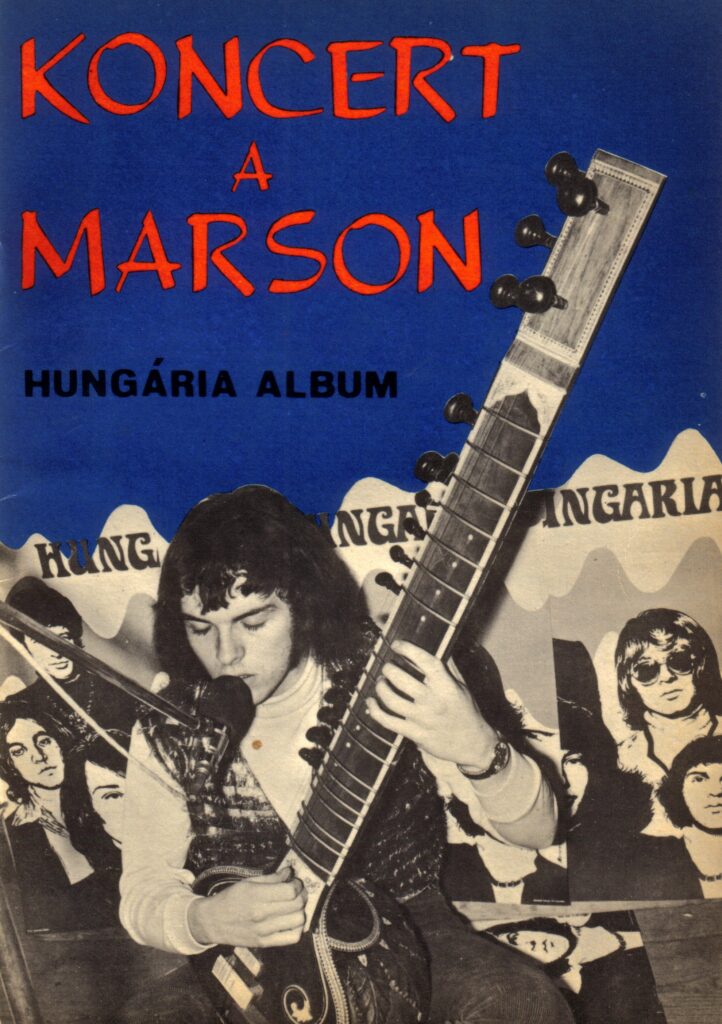
CONCERT ON MARS
Hungária’s First Album
In 1970, Hungária entered the studio to record its first album, Koncert a Marson—Concert on Mars.
Recording an album in Hungary at that time was very different from working in a modern studio. The converted cinema used by the state record company contained limited four-track equipment, an elementary mixing desk and difficult acoustics. The musicians themselves were also learning the possibilities and restrictions of studio recording as they worked.
During the sessions, Peter bought the instrument he had long wanted: his first Fender Precision Bass, the model played by one of his musical heroes, Jet Harris of The Shadows.
The album’s title and science-fiction concept gave Hungária an imaginative identity. For the cover photograph, the musicians and their equipment were taken into Budapest’s Pálvölgyi cave system, creating an underground landscape that could stand in for the surface of another planet.
Peter even carried a sitar into the cave. Inspired by George Harrison’s experiments with Indian music, he had bought the instrument from Fenyő’s father. Peter played and sang with it on “Szivárvány”, one of the album’s most distinctive tracks.
The recording also captured the increasingly close musical partnership between Peter and guitarist Tamás Barta. The two exchanged electric and acoustic guitar parts, drawing upon years of playing together and a shared fascination with the arrangements of George Martin.
Peter recalls that all 49,000 copies pressed of Koncert a Marson were sold—just one thousand below the figure then required for an official gold record.
Its success established Hungária as considerably more than a television talent-show discovery. The band now had a substantial body of recorded music and an audience eager to hear what would come next.
INSPIRED BY GEORGE MARTIN
Two tracks on Hungária’s 1971 album Tűzveszélyes—Flammable—offer an early glimpse of Peter’s developing ambitions as both composer and arranger.
A természet szava—The Sound of Nature—began as a melody recorded in Peter’s small notebook under the working title The Gift of Nature. The following day, he invited lyricist Tom Révész to his home to work on the song. Within minutes, Révész had written a complete lyric that followed precisely the emotions Peter had sought to express through the music.
Peter then made an important creative decision. He would arrange the song for a string orchestra, drawing inspiration from George Martin’s extraordinary work with the Beatles. The orchestral imagination of I Am the Walrus and Strawberry Fields Forever had been ringing in his ears day and night; to Peter, the two recordings represented the pinnacle of Martin’s achievement.
The same influence can be heard in Vöröshangyaboly—Red Anthill. The instrumental grew from a series of guitar riffs devised by Hungária’s gifted lead guitarist, Tamás Barta. Peter developed the string writing that frames the piece, creating its distinctive introduction and ending.
Together, the two recordings demonstrate the creative partnership at the heart of Hungária. They also reveal Peter already looking beyond the conventional instrumentation of a rock band, combining electric guitars and contemporary songwriting with the colour and dramatic possibilities of orchestral arrangement.
LISTEN
- A természet szava — composed and arranged by Peter Sipos; lyrics by Tom Révész
- Vöröshangyaboly — musical idea and guitar riffs by Tamás Barta; string introduction and ending by Peter Sipos

MUSIC FOR THE SCREEN
Hungária’s fascination with science fiction extended beyond the album sleeve.
In 1970, the title song from Koncert a Marson was filmed at the Hunnia Film Studio—an unusual opportunity for a Hungarian beat group at the time. The musicians were dressed as astronauts, climbed ladders and performed with their instruments against projected scenes taken from a science-fiction film.
By modern standards the resulting promotional film may have been charmingly improvised, but it represented something unusual and ambitious: an early Hungarian attempt to give a rock song its own visual world.
For Peter and his bandmates, it was also enormous fun.
THE SECOND ALBUM
Following the success of Koncert a Marson, Hungária began preparing its second album.
The band rehearsed in a small building in the garden of Péter Csomós’s family home. There, away from the stage and official studios, the musicians developed some of their most adventurous compositions and arrangements.
Peter contributed not only as a performer and songwriter but as an arranger. For Tamás Barta’s instrumental piece “Vöröshangyaboly,” Peter devised a symphonic opening and conclusion inspired by George Martin’s work with The Beatles.
The album was originally intended to be called Tűzveszélyes—Flammable. Photographer Miklós Csák created a striking series of colour photographs for the proposed cover.
By the time the record appeared in 1971, however, that version of Hungária had already broken apart. The elaborate proposed sleeve was abandoned and replaced by a much simpler design.
Peter remembers that, like the first album, the second release was limited to 49,000 copies. Once again, the entire pressing sold without producing the gold record that would have been awarded at 50,000.
The intended Tűzveszélyes photographs survive as a remarkable record of a band at its creative peak—even as its members were approaching the end of their first journey together.
THE FIRST CHAPTER ENDS
Success did not remove the personal and creative tensions within the band.
Different musical ambitions, financial disagreements and the pressures of continual work gradually damaged relationships between the members. Although concerts and recording commitments continued for a time, the group privately agreed that its existing form could not last.
Its final club performance took place in April 1971 at the Láng Gépgyár cultural hall in Budapest. The audience was told during the evening that it was witnessing the last appearance by that line-up.
The departure was remarkably abrupt. As Peter later compared it, Hungária seemed simply to stop from one moment to the next—much as The Beatles had done.
The musicians moved towards new projects. Tamás Barta joined the newly formed Locomotiv GT. Fenyő assembled another Hungária line-up. Peter accepted an invitation from László Pápay-Faragó and began the next important chapter of his career with Juventus.
But the Hungária story was not over.
HUNGÁRIA REBORN
At the beginning of 1973, changes within Juventus left Peter, Zoltán Kékes and Attila Csurgay considering what they should do next.
Standing together after a radio recording, Peter remembered hearing that Hungária’s music still attracted interest in East Germany. He proposed an idea that initially seemed unlikely: they should approach Miklós Fenyő and re-form Hungária.
Peter first travelled to Berlin to test the possibilities. He played recordings to music professionals at East German radio and to representatives of the Amiga record company. Their response was encouraging, confirming that the Hungária name still carried value beyond Hungary.
Armed with that interest, Peter contacted Fenyő and arranged a meeting at Budapest’s Dunapark café.
Their negotiations produced a new line-up. Peter insisted that Kékes and Csurgay should come with him from Juventus. Fenyő brought guitarist Antal Gábor Szűcs—known as “Totya.” For a time, the new group therefore possessed the unusual strength of two lead guitarists.
There was some discussion about abandoning the Hungária name and beginning again as Revolver. Peter argued that their opportunities in East Germany depended upon retaining the established identity.
The name survived, and Hungária was reborn.
Peter would remain with this new incarnation of the band until his departure from Hungary in 1979.
BACK IN THE STUDIO
The re-formed group moved quickly.
With the help of lyricist István S. Nagy, Hungária recorded two new songs at Hungarian Radio’s Studio 8: Fenyő’s hard-edged “Ne add el a lelkedet” and Peter’s ballad “Altatódal.”
Neither became a major hit, but the recordings announced that the band was active again.
Within weeks, Hungária travelled to East Germany to work on an album with popular singer Kati Kovács. That was followed by an extensive two-month tour of the Soviet Union, during which the company presented around fifty concerts.
The tour demonstrated both the reach of Hungarian popular music and the realities of performing within the Eastern Bloc. Before the first concert could proceed, the programme had to be approved by a Soviet official who initially considered the band too loud and too wild. Hungária reduced the volume, altered the presentation and secured permission to continue.
Once the concerts began, audiences often responded with extraordinary enthusiasm. The journey took the musicians from Moscow towards the Black Sea, through unfamiliar cities, difficult travelling conditions and experiences that would remain in Peter’s memory for the rest of his life.
THE BEATLES YEARS
Hungária’s line-up continued to evolve. In 1974, following the departure of drummer Attila Csurgay, the band auditioned a young musician named Róbert Szikora.
Szikora’s singing did not initially convince Peter, but his drumming left no doubt. He joined the band immediately.
His arrival marked the beginning of what Peter describes as Hungária’s “Beatles period.”
The group developed a show that celebrated the music, visual identity and exuberance of the 1960s. This was not merely a collection of cover versions. The band understood the humour, harmony and theatricality that had made The Beatles so compelling and built those qualities into its own stage personality.
The show became particularly successful in East Germany. At the Palace of the Republic in East Berlin, Hungária’s Beatles programme generated an audience response that Peter compared with Beatlemania.
The band’s international ambitions also took it beyond the accepted boundaries of the Eastern Bloc. In 1975, Hungária crossed into West Berlin to perform at the Quartier Latin club.
The musicians promoted the concert themselves, travelling around the city with posters, paste and brushes. Only a modest audience attended, but the significance of the appearance extended far beyond the size of the crowd.
For musicians from Communist Hungary, simply crossing from East to West Berlin represented an extraordinary act of cultural and personal freedom.
The door to the West had begun to open.
MUSIC ACROSS BORDERS
Hungária’s international work became an essential part of Peter’s experience with the band.
The group performed dozens of times in West Germany, bringing its music to audiences beyond Hungary and gaining valuable experience of the Western European entertainment industry. Hungária also toured extensively in East Germany, where its work led to regular television appearances, recording opportunities and enduring professional relationships.
Peter developed contacts with lyricists, broadcasters and record-company representatives on both sides of the divided country, often acting not only as a musician but also as organiser, negotiator and arranger.
In an age before email or digital recording, international collaboration required ingenuity. On one occasion, Peter completed arrangements overnight for a recording session in Berlin and carried the handwritten music to Budapest Airport at six in the morning. A friendly airline pilot transported the score on the morning flight and handed it to the waiting lyricist after landing.
THE FINAL PERFORMANCE
By the late 1970s, Peter’s relationship with Hungary had become increasingly difficult.
International travel had shown him worlds that appeared freer and filled with greater possibility. At the same time, the restrictions surrounding passports, professional opportunities and personal expression became harder to accept.
In 1979, while Hungária was performing in West Germany, Peter made the life-changing decision not to return home.
His final concert with the band took place in Braunschweig. He went onstage knowing that it would end not only his years with Hungária, but an entire chapter of his life as a Hungarian rock musician.
There was no opportunity for a formal farewell. He was leaving behind fellow musicians, friends, family and a professional identity built over more than a decade.
Peter remained in West Berlin while searching for a way to begin again. In 1980, he crossed the Atlantic and settled in Montreal.
The bass player from Budapest was about to start a new musical life.
THE HUNGÁRIA LEGACY
Hungária gave Peter much more than national recognition.
It taught him how songs are transformed through arrangement and rehearsal; how musicians with strong individual personalities can create something collectively; and how an audience can turn a performance into an event.
Within the band, Peter was never simply the person holding the bass guitar. He sang, composed, arranged, negotiated with broadcasters and record companies, helped organise international work and repeatedly influenced the musical direction of the group.
The photographs from these years preserve the outward story: the long hair, distinctive clothes, instruments, studios, tours and crowded stages.
Behind them lies another story—a young musician absorbing everything around him and developing the instincts that would later shape his work as a producer, recording artist and musical-theatre composer.
Hungária was not the beginning of Peter’s love of music.
But it was where that love became a life.