
MOZART ROCK
When Mozart Met Rock and Roll
Wolfgang Amadeus Mozart reimagined by Peter Sipos
Featuring Júlia Hamari
What might Mozart have written if he had lived in the twentieth century—and encountered electric guitars, synthesisers, drum machines and the recording studio?
That was the idea behind Mozart Rock, an imaginative 1985 collaboration between composer and arranger Peter Sipos and internationally acclaimed Hungarian opera singer Júlia Hamari.
The album preserved Mozart’s celebrated vocal melodies while replacing their original accompaniments with Peter’s contemporary arrangements. Rock, pop, jazz and electronic textures meet operatic singing in a project that brought two apparently distant musical worlds together.
THE STORY BEHIND MOZART ROCK
An Unexpected Meeting
The project began with a chance encounter in Montreal.
Friends in Toronto asked Peter to contact an acquaintance who was appearing with the Montreal Opera. The singer was Júlia Hamari, the distinguished Hungarian mezzo-soprano whose international career had taken her to many of the world’s leading concert halls and opera houses.
Peter attended a performance of Rossini’s The Barber of Seville in which Hamari was singing. Although he did not then consider himself an opera enthusiast, he found himself unexpectedly drawn into the performance.
When the two musicians met afterwards, they discovered a personal connection. Júlia had known Peter’s mother, opera singer and respected singing teacher Edit Fábry, and held her work in great admiration.
Peter was candid about his own relationship with classical music. It had surrounded him throughout childhood, but rock and roll had become the defining musical passion of his youth and professional career.
Júlia understood. Rather than regarding the two traditions as incompatible, she encouraged Peter to listen again.
INSPIRED BY AMADEUS
During Júlia’s visit, Peter Shaffer’s film Amadeus had just arrived in cinemas.
Júlia persuaded Peter to see it with her. The film’s portrayal of Mozart—and, above all, the music itself—made an extraordinary impression upon him.
Peter left the cinema wanting immediately to experience the entire film again. The music awakened memories of the Mozart songs and arias he had heard repeatedly as a child while his mother taught singers in the adjoining room.
Unable to sleep that night, Peter went into his Montreal studio and began playing Mozart on a synthesiser.
One melody returned particularly clearly: Cherubino’s aria Voi che sapete from The Marriage of Figaro. Working entirely from memory at first, Peter added rhythm, keyboards, voices and contemporary instrumentation.
By approximately six o’clock the following morning, he had completed a demonstration recording.
The experiment suggested a much larger possibility. Instead of composing modern songs loosely inspired by Mozart, Peter could retain the original vocal writing and construct entirely new arrangements around it.
He later summarised the idea very simply:
If Mozart were alive today, he might be playing guitar in a rock band.
FROM EXPERIMENT TO ALBUM
By the time Peter could contact Júlia, she had travelled to New York for an engagement at the Metropolitan Opera.
He sent her two demonstration recordings and waited to discover what an internationally recognised classical singer would make of his treatment of Mozart.
Her response was enthusiastic.
Júlia shared the recordings with musical colleagues in New York and arranged to visit Peter’s Montreal studio during a break in her schedule. There, she replaced Peter’s demonstration vocals with her own performances.
The combination worked. Júlia’s operatic voice retained its character, range and technical assurance, yet adapted remarkably naturally to Peter’s rhythms and contemporary arrangements.
She also introduced Peter to further classical works that she believed would speak to his musical instincts. A Bach aria revealed to him unexpected connections between Baroque bass lines and the foundations of later popular music.
This did not replace Peter’s love of rock. It widened his musical world. He began listening more closely to Bach, Beethoven, Verdi, Wagner, Richard Strauss and Mozart, often following orchestral scores to understand how their effects had been created.
The knowledge acquired during this period would prove invaluable when Peter began composing for musical theatre several years later.
REIMAGINING MOZART
Faithful Melodies, New Surroundings
Peter’s intention was not to simplify Mozart or turn the music into a novelty.
The vocal lines were treated with respect. The transformation took place principally in the accompaniments, instrumentation, rhythms and structure surrounding them.
Synthesised textures sit alongside electric guitar, bass and computerised drums. Elsewhere, woodwind, piano, strings and jazz-influenced colours enter the arrangements.
Ideas from different Mozart works occasionally meet within a single track. A passage associated with one opera might appear beneath an aria from another, creating musical connections that could not have existed in the original scores.
Among the album’s experiments:
- Material from The Magic Flute is placed in an unexpected new harmonic setting.
- The conclusion of La ci darem la mano from Don Giovanni moves from its original metre into a firmer rock pulse.
- Júlia performs both vocal parts of the Pamina and Papageno duet from The Magic Flute.
- Operatic passages are transposed to explore different colours within her remarkable vocal range.
- Peter joins Júlia for an Italian duet, contrasting her operatic delivery with his rock-influenced voice.
- Familiar melodies are accompanied by combinations ranging from layered voices and synthesisers to saxophone, woodwind and piano.
The result belongs completely to neither opera nor conventional rock. It occupies the territory between them—what would now readily be described as crossover music.
In 1985, that position was considerably less familiar.
RECORDING THE ALBUM
Following the success of the initial demonstrations, Júlia sent the recordings to Hungaroton in Budapest.
The company commissioned a complete album based upon Peter’s concept, with his arrangements and musical direction and Júlia as the featured singer.
Peter prepared much of the material in Montreal before travelling to Hungary. He programmed the rhythmic foundations and carefully developed the arrangements so that the recording sessions could proceed efficiently.
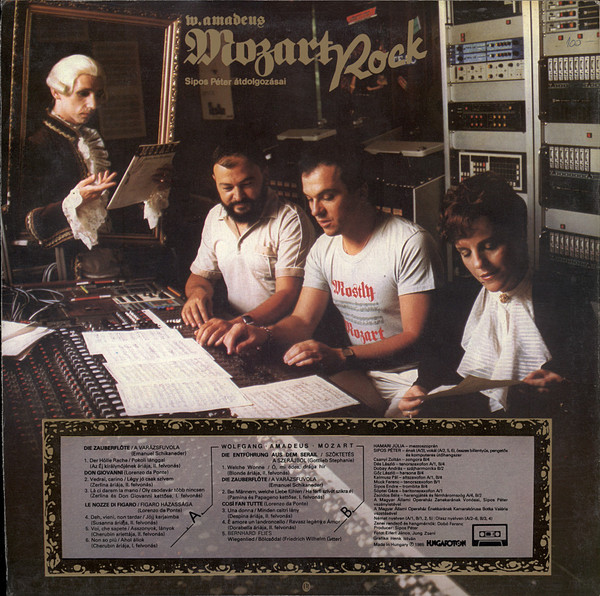
The album was completed at the Hungaroton studios in Törökbálint. Peter recorded keyboards, guitars and bass, after which additional musicians, wind players and orchestral strings were added.
Júlia’s exceptional musicianship allowed her to negotiate arrangements that sometimes placed Mozart’s melodies in different rhythms, keys or musical surroundings. What could easily have sounded forced instead became a genuine exchange between the operatic and contemporary traditions.
The sessions lasted approximately three weeks, followed by the final mixing and preparation of the album artwork.
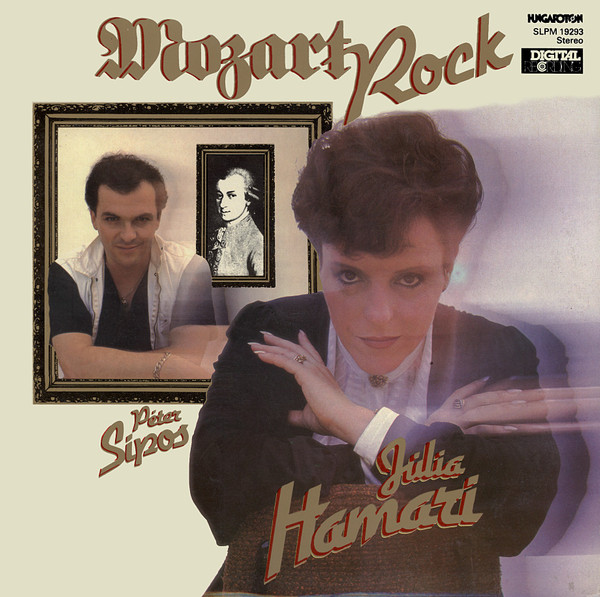
The sleeve photograph captured the character of the project perfectly: Peter and Júlia presented alongside Mozart himself, joining three musical worlds within a single image.
THE FINAL TRACK
The album closes with the familiar Cradle Song, long attributed to Mozart but now recognised as the work of Bernhard Flies.
Peter regarded it as one of the most moving recordings made during the sessions. After the album’s more audacious experiments, its gentler character provides a reflective conclusion.
The decision to retain the piece also says something important about the spirit of Mozart Rock. The album was not created merely to demonstrate studio technique. Behind the rhythms, electronic instruments and imaginative transformations remained a deep emotional response to melody.
RELEASE AND RECEPTION
Mozart Rock was released by Hungaroton in Hungary in 1985.
Peter subsequently presented the album to major record companies in Britain, including PolyGram, K-Tel, Decca and EMI. The response revealed the difficulty of introducing crossover music at that time.
For some classical listeners, the album was too closely associated with popular music. For rock and pop audiences, Júlia’s operatic performance could seem too classical. Its greatest originality also made it difficult to categorise.
A Japanese CD edition was subsequently released under licence by Denon, giving the project an international life beyond its original Hungarian edition.
Although the album did not become a mainstream commercial success, Peter considered its creation an achievement in itself. It allowed him to realise a concept that was daring for its time and to work with an artist of exceptional international standing.
More importantly, it reconnected him with the classical music of his childhood and contributed to the musical vocabulary he would later bring to his theatrical scores.
LISTEN TO MOZART ROCK
Two Musical Worlds Meet
These selected tracks introduce the contrasting voices and arrangements of Mozart Rock.
Voi che sapete
From The Marriage of Figaro
Cherubino’s celebrated aria was one of the pieces that first returned to Peter’s memory after seeing Amadeus. Its transformation in his Montreal studio helped inspire the entire album.
La ci darem la mano
From Don Giovanni
Peter and Júlia bring their contrasting musical backgrounds together in this duet: an internationally acclaimed operatic voice meets Peter’s rock-influenced performance within a newly imagined arrangement.
Cradle Song
Music by Bernhard Flies, formerly attributed to Mozart
A gentler and more reflective recording that closes the album, demonstrating the importance of melody and emotional expression beneath its experimental concept.
A BRIDGE BETWEEN TWO WORLDS
*Mozart Rock* occupies a distinctive place in Peter Sipos’s career.
It connects his mother’s world of opera with the rock music that shaped his youth. It links his Canadian studio work with his continuing creative relationships in Hungary. It also anticipates the combination of popular melody, trained voices and orchestral colour that would later characterise his work in musical theatre.
What began as a sleepless night at a synthesiser became a complete album—and opened a musical door that Peter would never entirely close.
Explore the complete Mozart Rock recording on the Songs and Recordings page.